Probably an overshare, but it’s interesting information!
This is the data coming from my sensor over the last 7 days or so, where it has been mostly been in my bedroom collecting Co2 data (Carbon Dioxide).
Carbon Dioxide is what we (the humans amongst us) breathe out, and what was quite staggering from this simple bit of data collection was that the level of Co2 just keeps building through the night unless you’re actively making sure you have decent ventilation.
As you can see here, the first spike was a pretty stable range of 1250-1600 Co2 ppm, which is standard really. The next night I opened the window a little way – which kept the max 1250 Co2 ppm – which was way better.
Next night (06/07 on the chart) spiked higher as I closed the window again to verify.
Following eve, window open again AND bedroom door open. Max readings of 1000 Co2 ppm. Win.
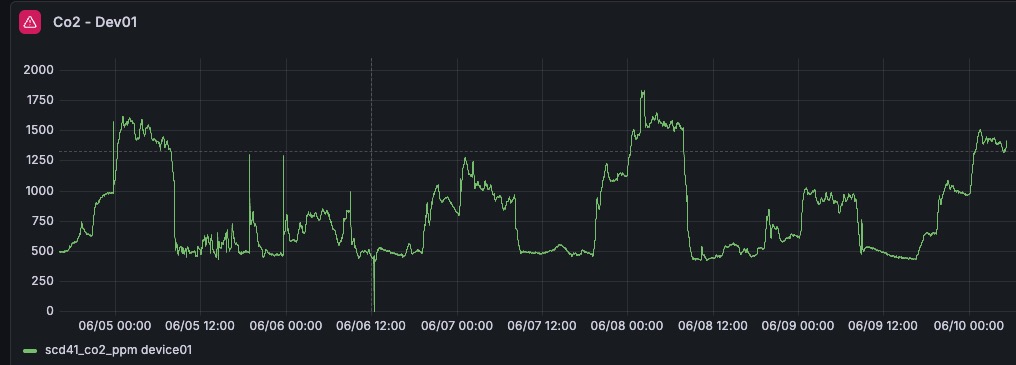
Data based on 2 people, in a small room sized around 4m x 9m, standard ’30s semi-detached height walls.
Once crazy thing I noticed was the Co2 soon started to rise from the kids in their rooms – even though the rooms are at the other end of the hall. Impressive sensitivity coming from the dedicated Co2 sensor!
Fundamentally, Co2 was not something I had paid much attention to over the years, but having this sensor has made me adjust the ventilating through the night, rather than just ‘I’m cold I’ll leave everything closed and sealed up!’
Until next time.
Chris.
Context: CO₂ here is a proxy for ventilation, not the pollutant itself.
FYI some data / reference ‘Home carbon dioxide levels’
Indoor CO₂ levels: sleep, safety and cognitive performance.
CO₂ levels indoors: quick reference table
| CO₂ level | Rating | What it usually suggests |
|---|---|---|
| ~420 ppm | Outdoor baseline | Fresh outdoor air reference point |
| Under 700 ppm | Excellent | Very well ventilated indoor air |
| 700–800 ppm | Very good | Good practical target for bedrooms and occupied rooms |
| 800–1,000 ppm | Acceptable | Common indoors, but worth watching overnight |
| 1,000–1,500 ppm | Elevated | Ventilation could be improved |
| 1,500–2,000 ppm | Poor | HSE says consistent levels above 1,500 ppm indicate poor ventilation |
| 2,000–3,000 ppm | Very poor | Stuffy air; more likely to affect comfort and alertness |
| 3,000–5,000 ppm | Extremely poor | Not suitable as a normal indoor level |
| 5,000 ppm+ | Workplace limit area | Above the UK 8-hour workplace exposure limit if sustained |
| 15,000 ppm+ | Short-term limit area | Above the UK 15-minute workplace exposure limit |
CO₂ and sleep: bedroom guide
| Overnight CO₂ pattern | Sleep interpretation |
|---|---|
| Mostly under 800 ppm | Excellent bedroom ventilation |
| Mostly 800–1,000 ppm | Generally reasonable |
| Regularly over 1,000 ppm | Worth improving ventilation |
| Regularly over 1,500 ppm | Poor ventilation for sleep |
| Peaks over 2,000 ppm | Strong sign the room is under-ventilated |
| Peaks over 3,000 ppm | Very poor bedroom air; investigate ventilation |
A useful sleep target is to keep the bedroom mostly below 1,000 ppm, and ideally closer to 800 ppm or below where practical.
CO₂, concentration and cognitive performance
| CO₂ level | Possible effect |
|---|---|
| Under 800 ppm | Good ventilation; best target for focus |
| 800–1,000 ppm | Usually acceptable, but not ideal for long periods |
| 1,000–1,500 ppm | Some studies link this range with reduced performance or increased symptoms |
| 1,500–2,000 ppm | Poor ventilation; more likely to feel stuffy or tiring |
| 2,000 ppm+ | More likely to affect alertness, comfort and perceived air quality |
Important note: at normal indoor levels, CO₂ is often a marker of poor ventilation, not the only cause of symptoms. If CO₂ is high, other human-generated pollutants, odours, moisture and airborne particles may also be building up.
CO₂ workplace context, UK
| CO₂ level | Workplace meaning |
|---|---|
| Under 1,500 ppm | Usually acceptable as a ventilation indicator |
| Consistently over 1,500 ppm | HSE says this indicates poor ventilation and action should be taken |
| 5,000 ppm | UK 8-hour workplace exposure limit |
| 15,000 ppm | UK 15-minute short-term exposure limit |
Workplace exposure limits are not comfort targets. A room can be far below the legal workplace CO₂ limit and still be poorly ventilated for comfort, sleep, concentration or infection-risk reduction.
CO₂ is one of the easiest ways to see whether a room is getting enough fresh air for the number of people in it. For homes, bedrooms, offices and classrooms, the useful range is not the legal workplace limit. The practical target is much lower.
As a rule of thumb:
| CO₂ reading | Plain-English summary |
|---|---|
| Under 800 ppm | Good |
| 800–1,000 ppm | Okay |
| 1,000–1,500 ppm | Needs attention |
| Over 1,500 ppm | Poor ventilation |
| Over 2,000 ppm | Very poor indoor air |
| Over 5,000 ppm | Not acceptable as a sustained workplace level |
CO₂ does not measure everything. Low CO₂ does not prove that PM2.5, VOCs, humidity, mould, combustion gases or odours are fine. It mainly tells you whether enough fresh air is reaching the space.
bedroom ventilation and sleep, which hits two of your themes (ventilation and sleep) and a question loads of people quietly have. Verified against the actual paper.
What about the actual scientific data?
A 2025 evidence review found that stuffy, under-ventilated bedrooms let carbon dioxide climb high enough to measurably disturb sleep — and that many current ventilation standards are too lax to prevent it.
Summary: Researchers pooled the evidence from 17 studies on bedroom air and sleep and reached a clear conclusion: when a closed bedroom lets CO₂ rise past about 1,000 ppm — a sign there isn't enough fresh air — sleep quality drops, and keeping it at or below roughly 800 ppm is the safer target. The catch is that hitting that needs around 8 litres of fresh air per second per person, at least double what many current standards ask for. CO₂ here isn't the villain itself; it's the visible signal that a room has gone stuffy. Source data 2025 review, Science and Technology for the Built Environment: a synthesis of 17 studies finding that bedroom CO₂ above ~1,000 ppm (a marker of poor ventilation) disturbs sleep, and that many ventilation standards are too lax. Peer-reviewed review.[the bottom-line recommendation for a sleeping room CO₂ from the people in it]
Science and Technology for the Built Environment (Akimoto et al., 2025) clinicaltrials
“should, as a minimum, remain below 1,000 ppm”
What the research tells us This was a review rather than a single experiment — the team gathered 17 studies (22 experimental datasets) measuring both bedroom ventilation and sleep, and looked for the point where air quality starts to bite. Their answer: sleep gets disturbed once CO₂ from sleeping occupants reaches around 1,000 ppm, so they argue ventilation should keep it lower, nearer 800 ppm.
The mechanism is refreshingly simple. Shut the bedroom door and window and your own breathing slowly loads the room with CO₂ overnight. The CO₂ itself is mostly a stand-in — it acts as a proxy for how much fresh outdoor air is getting in, rather than being the main pollutant. A small room with two people and the window closed reaches the stuffy zone surprisingly fast.
Two honest caveats. This is a synthesis of mostly small experimental studies on healthy adults, and because CO₂ is an indicator of poor ventilation rather than proven to be the sole cause, it’s better read as “ventilate your bedroom better” than “CO₂ is poisoning your sleep.” And for transparency, the work was sponsored as part of an ASHRAE project — a building-standards body — which is exactly who’d want ventilation guidance revisited!
For UK homes the relevance is direct. We shut bedroom windows for warmth, noise and security through much of the year, and newer or recently-insulated homes are far more airtight than the draughty stock we used to live in — so the fresh-air exchange this review cares about is precisely what’s missing.
The fixes are cheap: leave a window on the vent latch, open the trickle vents most UK windows already have, or crack the door. And because “stuffy” is invisible, a small bedroom CO₂ monitor is the one thing that turns it into a number you can actually act on — watch it climb past 1,000 and you’ll know to let some air in.
Topics bedroom ventilation · CO2 · sleep quality · indoor air quality · airflow · health · sensors & monitoring